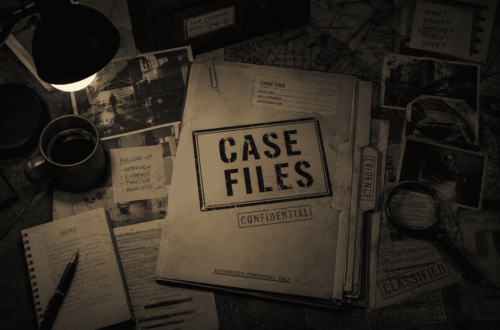
STATUS: ACTIVE
CLASSIFICATION: INTERNAL RECORD
CLEARANCE LEVEL: RESTRICTED
The first letter arrived on a rainy Thursday morning.
Daniel Mercer almost threw it away.
The envelope had no return address, no postage stamp, and no indication of how it had reached his desk inside the station office. The paper looked decades old, its edges yellowed with age, as though it had spent years hidden inside an attic before somehow finding its way into his hands.
The name written on the front meant nothing to him.
Evelyn Carter.
Daniel assumed it had been delivered by mistake.
The station handled lost property, mail transfers, and abandoned parcels from time to time. Strange deliveries weren’t uncommon. He placed the envelope aside and returned to work, intending to deal with it later.
Curiosity got the better of him before lunch.
Inside was a handwritten letter dated March 1945.
The author identified himself as Thomas Reed, a soldier stationed overseas during the final months of the war. The contents weren’t unusual at first. He wrote about missing home, dreaming of the future, and counting the days until he could return.
But the emotion in the letter felt startlingly real.
Every sentence carried the weight of someone desperately trying to hold onto hope.
At the end of the page, Thomas wrote:
“I’m coming home to marry you. Wait for me at our bookstore.”
Daniel folded the letter carefully and placed it back inside the envelope.
He assumed that would be the end of it.
It wasn’t.
The following Thursday, another letter appeared.
Then another.
And another.
Every week, without fail.
Always on a Thursday.
Always during the rain.
Always addressed to Evelyn Carter.
The letters formed a story.
A relationship.
A future that had never happened.
Thomas described wedding plans, dreams of opening a larger bookstore, and promises to return home no matter what happened overseas. Some letters were romantic. Others were frightened. A few hinted that something was wrong.
Then Daniel noticed a sentence appearing repeatedly.
At first it seemed insignificant.
By the fifth letter, it became impossible to ignore.
“If these letters stop coming, it means they found me.”
The phrase appeared again and again.
Sometimes at the end of the page.
Sometimes hidden between paragraphs.
Sometimes written so lightly it was almost invisible.
The words transformed a love story into something else entirely.
Daniel became obsessed.
The station where he worked had existed since before the war. Thousands of people passed through every year, yet nobody could explain why letters written in 1945 were suddenly appearing on his desk decades later.
He began researching Evelyn Carter.
The results were strange.
Older residents remembered her.
But nobody liked discussing her.
Whenever Daniel asked questions, conversations ended abruptly.
Some claimed Evelyn had suddenly left town.
Others insisted she remained there for years after the war, arriving at the station every week to watch incoming trains.
According to local stories, she never stopped waiting.
The contradictions only deepened the mystery.
Then Daniel met Clara Carter.
Clara was Evelyn’s granddaughter and one of the few people willing to discuss the past. She had grown up hearing fragments of family stories but had never learned the full truth. Her grandmother rarely spoke about Thomas Reed, and when she did, the conversations always ended in tears.
Together, Daniel and Clara began piecing the story together.
The deeper they dug, the more disturbing the records became.
Military archives stated that Thomas Reed died during combat operations in Europe shortly before the war ended.
Yet several documents contradicted that conclusion.
Transportation records suggested he returned to American soil months later.
A passenger manifest listed his name aboard a military vessel.
A train log recorded a ticket issued in his name.
Most troubling of all, a government document referenced Thomas Reed nearly six months after his supposed death.
Someone had altered the official record.
Someone wanted Thomas Reed erased.
The discovery changed everything.
The letters no longer looked like delayed correspondence.
They looked like evidence.
Each one contained subtle references to meetings, locations, and individuals Daniel couldn’t identify. Certain names appeared repeatedly, only to vanish from public records entirely.
It was as though Thomas had been leaving clues.
Not for Evelyn.
For whoever found the letters decades later.
Then came the final envelope.
Unlike the others, it remained sealed.
The paper looked newer.
The handwriting appeared rushed.
Across the front, Thomas had written only one instruction.
“Open this last.”
Daniel and Clara waited until they had exhausted every lead before opening it.
Neither was prepared for what they found inside.
The final letter contained no declaration of love.
No wedding plans.
No promises.
Instead, it described a meeting Thomas claimed to have witnessed shortly before his disappearance.
According to the letter, several powerful individuals had gathered in secret to discuss a wartime operation that officially never existed.
At the bottom of the page was a single name.
A name both Daniel and Clara immediately recognized.
The name belonged to one of the town’s most respected historical figures.
A man whose statue still stood in the town square.
A man celebrated every year as a local hero.
Thomas claimed he was responsible.
––––––––––––––––––––––––––––––––
INVESTIGATIVE ADDENDUM
The appearance of the letters triggered renewed interest in the disappearance of Evelyn Carter and the unexplained fate of Thomas Reed.
Subsequent analysis confirmed that the paper, ink, and handwriting were consistent with materials available during the 1940s. However, investigators were unable to determine how the letters repeatedly appeared inside the train station without passing through any documented postal system.
Research into Thomas Reed revealed extensive irregularities.
Military records listed him as deceased.
Transportation records suggested he survived.
Several supporting documents disappeared shortly after being requested by independent researchers.
The inconsistencies remain unresolved.
More alarming were discoveries connected to the final letter.
The individual named by Thomas held significant influence throughout the region during the late 1940s. While no direct evidence linked him to criminal activity, archived newspaper reports revealed multiple witnesses who vanished, changed testimony, or abruptly left town after making allegations connected to wartime contracts.
Investigators now believe Thomas Reed may have uncovered information unrelated to the war itself.
Information powerful enough to justify the destruction of records and the suppression of witnesses.
The whereabouts of Evelyn Carter’s original correspondence remain unknown.
Many believe additional letters existed.
None have been recovered.
The final documented event occurred three weeks after Daniel and Clara opened the last envelope.
Security footage from the train station captured an unidentified individual placing a new envelope on Daniel’s desk during a thunderstorm.
The footage corrupted moments later.
The envelope disappeared before authorities arrived.
No one has seen it since.
Witnesses claim only three words were written on the front.
“There’s more.“
CASE STATUS: OPEN
THOMAS REED STATUS: UNKNOWN
EVELYN CARTER STATUS: DECEASED
UNIDENTIFIED SUBJECT STATUS: ACTIVE
THREAT ASSESSMENT: ONGOING