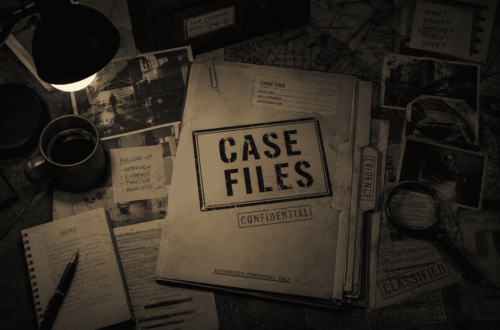
STATUS: ACTIVE
CLASSIFICATION: INTERNAL RECORD
CLEARANCE LEVEL: RESTRICTED
Marcus Webb had spent more than a decade inside a radio booth that never truly changed.
WKRL’s overnight shift was a world of static, distant truckers on long highways, and the quiet hum of equipment that filled the silence between songs. Most nights blurred together. The same callers. The same requests. The same stretch of hours where nothing meaningful ever happened.
Marcus preferred it that way.
Dead air was easier than conversation.
At least until the calls began.
The first one arrived at 2:47 a.m. on a night like any other.
The phone rang once before the voice came through.
A woman.
Soft.
Unsteady.
She introduced herself as Carla Reyes.
The name meant nothing to Marcus at first. Missing persons calls were not unusual in radio work. People sometimes phoned in with stories, confessions, or desperate attempts to reach someone who would never pick up again.
But something about this call felt different.
Carla said she had been missing since 1989.
Then she described the shoes she had been wearing the night she disappeared.
A detail that had never been released publicly.
Not in police reports.
Not in news archives.
Not in any public record Marcus could find.
He assumed it was a hoax.
A cruel joke from someone who had done too much digging.
The next morning, he pulled archived emergency recordings from old police databases, trying to match the voice.
What he found unsettled him.
The audio pattern was identical.
Same cadence.
Same breathing rhythm.
Same slight stutter on the “S” sounds.
It wasn’t just similar.
It matched too precisely to be coincidence.
By the third night, another call came.
Then another.
Each one claimed to be a missing person.
Different names.
Different years.
Different cases.
But every caller carried knowledge they shouldn’t have had.
Private details from sealed files.
Descriptions of crime scenes never released to the public.
Information only investigators should have known.
Marcus began recording everything.
He told himself it was research.
Content for a future segment.
Something to explain later when the calls inevitably stopped.
But they didn’t stop.
The station started to feel different.
He noticed small things first.
Static that appeared only when the phone rang.
Brief distortions in the audio feed during live calls.
Equipment that functioned normally during the day but behaved unpredictably at night.
Then came the seventh caller.
There was no name.
No introduction.
Just silence for several seconds before a voice spoke directly into the microphone.
“Marcus,” she said.
Not asking.
Not guessing.
Knowing.
“Stop asking who we are.”
A pause.
Then the words that changed everything.
“Start asking who is making us talk.”
The line disconnected.
No dial tone.
No static.
Just an abrupt cut into silence.
Marcus sat frozen in the booth, headphones still on, staring at the blinking call light as if it might ring again immediately.
It didn’t.
Instead, something outside caught his attention.
Through the glass wall of the station, he noticed a car in the parking lot.
It had been there since midnight.
Engine running.
Lights off.
Perfectly still.
Waiting.
––––––––––––––––––––––––––––––––
INVESTIGATIVE ADDENDUM
Marcus Webb continued his overnight shifts for three more days after the final call.
According to station logs, he did not report the incident to management or local authorities.
He did, however, begin cross-referencing the incoming calls with archived missing persons databases.
Several inconsistencies emerged.
Multiple cases linked to the calls had been officially closed years earlier, with conclusions ranging from accidental death to unresolved disappearance.
Yet the voices on the radio appeared to know details that were never included in public documentation.
Some referenced locations later confirmed to be correct.
Others described personal items never recovered.
All matched with disturbing accuracy.
On the fourth night, broadcast logs recorded a prolonged period of silence lasting 6 minutes and 14 seconds.
During that window, no outgoing transmission was detected from the station.
However, external receivers located within a 12-mile radius reported intermittent audio interference.
Patterns consistent with speech were identified, though no intelligible words were recovered.
At 3:11 a.m., Marcus’s broadcast feed abruptly switched to automated programming.
He was not present in the booth.
Security footage shows the parking lot vehicle remaining stationary for 47 minutes after the station went silent.
Then, without warning, both the vehicle and Marcus Webb disappeared from all recorded systems.
No exit was captured.
No roads were used.
No external contact was recorded.
Subsequent investigation into WKRL archives revealed anomalies in the station’s emergency broadcast system.
Several recordings contained faint overlapping voices not present in the original live calls.
Forensic audio specialists concluded that the recordings were not externally transmitted.
They appeared to originate from within the station’s own equipment.
The origin of these signals has never been identified.
The missing persons cases referenced during Marcus Webb’s broadcasts remain officially closed.
However, internal notes appended to several files contain a recurring phrase written in different handwriting styles:
“They are not calling you.”
“You are receiving them.”
CASE STATUS: OPEN
MARCUS WEBB STATUS: MISSING
CALLER ORIGIN STATUS: UNKNOWN
THREAT ASSESSMENT: HIGH