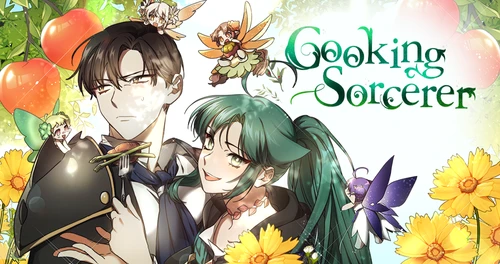
I recently finished reading a manga called Cooking Sorcerer, and when I reached the final chapter, I did something I don’t usually do.
I just sat there.
Not because I was confused.
Not because I was disappointed.
But because the story simply… stopped.
There wasn’t a massive final battle. There wasn’t a dramatic declaration that wrapped every loose end in a neat little bow. There wasn’t a scene where every villain received punishment or every mystery was explained.
The story simply reached a point where it felt comfortable enough to let go.
And I realized I actually liked that.
The premise itself is fairly simple.
A prince spends years being poisoned by people around him until his body and mind learn to associate food with danger. Eventually, he loses much of his ability to enjoy eating at all. He survives mostly on fruit and water because everything else feels like a threat.
Then he meets someone whose greatest joy happens to be cooking.
What I appreciated was how patient the story was.
She doesn’t decide she’s going to “fix” him overnight.
She doesn’t pressure him to conquer his fears because she believes in him.
She doesn’t give an emotional speech about trusting people again.
Instead, she starts where he’s already comfortable.
Fruit.
Then fruit juice.
Then porridge.
Then small snacks.
Little by little.
Every meal becomes less about food and more about rebuilding trust.
As I was reading, I realized the story wasn’t really asking, “Can he eat again?“
It was asking, “Can someone who has spent years expecting pain learn to expect comfort instead?”
Those are two very different questions.
The first is about the body.
The second is about the heart.
One thing I found myself thinking about was how often stories rush recovery.
A character experiences years of trauma, and somehow one conversation, one dramatic rescue, or one life-changing event makes everything okay.
Reality doesn’t usually work like that.
People don’t unlearn fear in a single day.
Trust isn’t rebuilt in one conversation.
Healing doesn’t happen because someone tells you you’re safe.
It happens because, over time, your experiences begin to prove that you are.
That is exactly what this story captures.
Every meal is evidence.
Every small success quietly replaces an old memory with a new one.
The return of his appetite isn’t treated like magic.
It’s treated like practice.
By the end of the story, he still isn’t completely healed.
There are certain foods he still struggles with. Some memories still linger. His body still remembers the years of pain.
And I actually loved that.
Sometimes progress is more believable than perfection.
What surprised me most, though, was the ending itself.
It doesn’t tell us exactly what happens next.
It doesn’t insist on showing a perfect future.
Instead, it simply leaves the characters at a point where they are healthier than they were when we first met them.
Some readers don’t enjoy open endings because they want certainty.
I understand that.
But I’ve started to appreciate stories that trust the reader enough to imagine the rest.
Not every ending needs to answer every question.
Sometimes the purpose of an ending isn’t to tell us exactly what happens.
Sometimes it’s to show us that the characters are finally capable of choosing their own future.
And maybe that’s enough.
The more I thought about it, the more I realized this ending reminded me of something I don’t think we celebrate enough.
There are stories about revenge.
Stories about victory.
Stories about justice.
But there are also stories where the greatest achievement is much quieter.
Someone who couldn’t trust learns to trust again.
Someone who couldn’t enjoy a meal finds themselves looking forward to the next one.
Someone who spent years surviving finally begins living.
No explosions.
No grand speeches.
No dramatic final confrontation.
Just a person realizing that something which once caused fear has slowly become a source of comfort.
For me, that was more satisfying than another perfectly wrapped “happily ever after.”
Because life doesn’t always end with certainty.
Sometimes it ends with possibility.
And maybe that’s one of the happiest endings a story can give us.